

Vlogging and content creation are catching up at a rapid pace across the world. If you too want to share your life with millions of users on the internet, all you have to do is pick up a camera and upload videos on any platform of your choice. However, everyone may not have a camera lying around to make videos. So if you’re just starting off, we’ve listed some of the best budget vlogging cameras under £500.
With ever-evolving technology, you don’t have to spend top bucks for a good camera. We’ve included several options that can record in 4K, have flip-out screens, and can even zoom in quite far. Pick the one based on your usage. Let’s now get to some of the best cameras for vloggers on a budget. But before that –
- Take a look at some travel gadgets in the UK to enhance your travel experience.
- View your pictures on a large screen by getting a digital photo frame.
- Charge all your gadgets on the go using USB travel adapters with multiple ports.
1. Insta360 Go 3
Video resolution: 2.7K

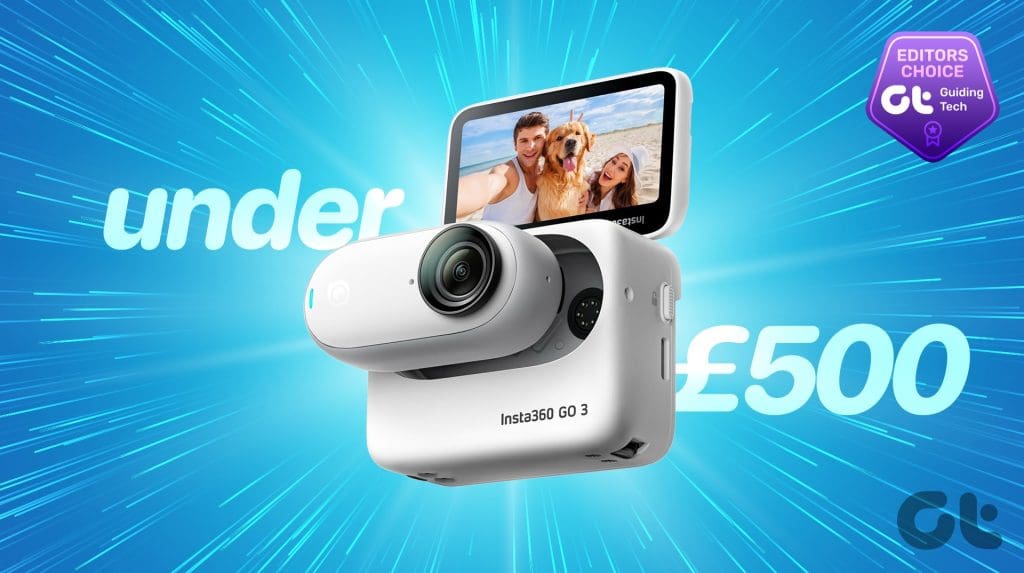
A vlogging camera needs to be versatile. Whether you’re vacationing at the beach or simply recording a commute, a vlogging camera should ideally be able to handle all situations with ease. And that’s where the Insta360 Go 3 shines with its tiny form factor.
The Insta360 Go 3’s USP is portability. The actual camera module is the size of a human thumb and has a magnetic surface on the rear. Thanks to this, you can simply snap the camera onto any metallic surface or use the necklace attachment in the box to record first-person PoV footage.
While you can use the tiny camera unit to record yourself, the Go 3’s charging cradle also doubles up as a viewfinder. Simply snap the camera into the case and flip up the screen to frame yourself when vlogging. Since the camera is water-resistant up to 16ft, you can even capture some cool underwater shots when you head out for a swim.
Insta360’s stabilization is top-notch, which makes the Go 3 perfect for vlogging when walking around. If anything, the 45-minute battery life of the camera unit might be a bummer if you wish to vlog a full day. However, attaching the camera to the charging unit or Action Pod increases the battery life to three hours, which is respectable.
What We Like
What We Don’t Like
2. Canon PowerShot V10
Video resolution: 4K

While the Insta360 Go 3 is more of an action camera that can also be used for vlogging, the options that follow are full-fledged cameras with much larger sensors. The PowerShot V10 from Canon is one of them, and it has been designed with vloggers and content creators in mind.
Canon has included several design elements on the PowerShot V10 that make it an excellent fit for vloggers. For example, the camera gets a flippable screen to help you frame yourself when vlogging. Secondly, the unit features a built-in tripod at the bottom to rest the camera on any surface. This feature is extremely underrated if you’re shooting by yourself.
The built-in stereo mics offer crisp audio, so you don’t necessarily have to invest in a dedicated mic. It’s not just about these bells and whistles, though. The PowerShot V10 has a large 1-inch sensor that performs well even in low-light situations. Moreover, the camera is compact so it fits right into your pocket.
There are a few downsides to the Canon PowerShot V10 like the average battery life and poorly designed companion app. As a result of the latter, it’s a pain to transfer media from the camera to your phone if you quickly want to edit photos or videos. However, if you’re looking for a budget vlogging camera with a flip-out screen and a built-in tripod, you can surely consider the V10.
What We Like
What We Don’t Like
3. Panasonic Lumix DMC-TZ100
Video resolution: 4K

Here’s another camera with a 1-inch sensor. The Panasonic Lumix TZ100 is a point-and-shoot camera with optical zoom capabilities. So if you want to create travel vlogs and record faraway objects or scenes, you should consider getting Panasonic’s offering.
The cameras mentioned previously only support digital zoom. So if you want to capture faraway objects, you will have to compromise on the image quality. You don’t have to worry about that if you get the Panasonic Lumix DMC-TZ100. Not just zooming into objects, but the optical zoom capabilities are also handy if you wish to capture portraits of friends and family.
You can record at up to 4K using the TZ100, but with one limitation — the frame rate is capped at 25fps. So if you’re ‘Team 30fps’, look elsewhere. However, both the photo and video quality are excellent, as per reviews. Users also mention the camera’s autofocus capabilities are in a league of their own, which makes the DMC-TZ100 great for vlogging.
What We Like
What We Don’t Like
4. Sony RX100 IV
Video resolution: 4K

Sony’s RX100 series of cameras have long been the default option for point-and-shoot cameras. The recent iterations have improved the range’s video recording and autofocusing capabilities, making the RX100 IV a worthy contender for a budget vlogging camera.
One of the biggest selling points of the RX100 over the Panasonic TZ100 for vloggers is the flippable screen. We say this as you can seamlessly ensure you’re in the frame if you have a display to refer to at all times. The camera also comes with a 1-inch sensor, and reviews say it captures excellent photos with lots of details. Sony’s colour science makes images pop, so if you like vibrant pictures, you’re going to love the RX100.
While the optical zoom range isn’t as high as the Lumix TZ100, the Sony RX100 has a wider aperture, so it lets in a lot more light when shooting in the dark. This can be a deciding factor for many. If you want better zoom, pick Panasonic’s contender. But, if you plan on recording videos at night, the Sony RX100 IV is the way to go.
Users also mention that the RX100 IV does a great job at capturing moving subjects like kids and pets. It’s worth noting that there are newer versions of the RX100 with improved features. However, they are considerably more expensive. If you’re just starting off, the RX100 IV should be sufficient.
What We Like
What We Don’t Like
5. Sony Vlog Camera ZV-1F
Video resolution: 4K

In the past couple of years, Sony has developed several cameras directly aimed at vloggers and content creators. The ZV-1F is one such camera. While there are cameras like the ZV-E1 and ZV-E10 with interchangeable lenses in this series, the ZV-1F has a fixed lens and is, therefore, more affordable.
While the ZV-1F is slightly over the £500 budget, there are some features that it offers that may compel you to spend the extra few bucks. For starters, it’s lighter than the RX100, so it’s easier to carry. And since the sensor isn’t as large as the one on the RX100, Sony gives you the ability to blur the background using AI.
Think of it as portrait mode but for videos. If you’re shooting product videos or capturing close-up objects, Sony naturally adds a bokeh effect to make the subject stand out. Sony has also included a sophisticated mic with a windscreen on top of the camera chassis. So, you won’t need an external mic when vlogging outdoors.
The Sony ZV-1F also allows you to live stream and wirelessly transfer media from the camera to your phone. If you’re a beginner and just starting off with vlogging, the Sony ZV-1F is a good place to start. We wish Sony included the same 1-inch sensor from the RX100, though along with a wider aperture.
What We Like
What We Don’t Like
FAQs for Budget Vlogging Cameras
Most vlogs are shot at a fixed focal length unless you want to zoom in to show a faraway subject. Hence, a camera with a fixed lens should be good enough for vlogging. You can consider a camera with optical zoom instead since it’s more affordable and easier to carry around.
Several professional vloggers use high-quality DSLR or mirrorless cameras to record their vlogs. This is because such cameras offer excellent image quality. However, mirrorless cameras are heavy, expensive, and a lot of times, impractical to use for vlogging. Most beginners should be fine with any of the cameras mentioned above. You can gradually make your way to more expensive equipment.
Of course! The best camera is the one you currently have with you. If you’re a beginner or you don’t want to splurge on a new camera, it’s best to start vlogging using your smartphone. We suggest using the main camera on the rear instead of the front-facing one since it would have the best output.
Record Your Everyday Life
With millions of creators on the internet, creating quality content is more important than ever. If you wish to showcase your everyday life on YouTube or other streaming websites, pick up any of the best budget vlogging cameras under £500 from the list above, and you’ll be ready to upload some high-quality content!
Was this helpful?
Last updated on 04 August, 2023
Read Next
 Best 3 Point and Shoot Cameras for Vlogging on a Budget
Most of us are pretty comfortable enough with the cameras built-in to our smartphones that we don’t need dedicated cameras anymore.
Best 3 Point and Shoot Cameras for Vlogging on a Budget
Most of us are pretty comfortable enough with the cameras built-in to our smartphones that we don’t need dedicated cameras anymore.
 6 Best Vlogging Cameras With Flip Screens
Vlogging and recording one's personal life has quickly become the interest of many on YouTube.
6 Best Vlogging Cameras With Flip Screens
Vlogging and recording one's personal life has quickly become the interest of many on YouTube.
 6 Best Mini Action Cameras for Vlogging
Tiny, pocketable cameras seemed a pipe dream a few years ago but they're now all over the place.
6 Best Mini Action Cameras for Vlogging
Tiny, pocketable cameras seemed a pipe dream a few years ago but they're now all over the place.
 4 Best Pocket Cameras for Vlogging in 2023
Vlogging is a great way to document your everyday life.
4 Best Pocket Cameras for Vlogging in 2023
Vlogging is a great way to document your everyday life.
 4 Best Budget Portrait Lenses Under $250 for Canon Full Frame Cameras
Since portrait mode has made its way to smartphones, the number of people clicking portrait images has significantly increased.
4 Best Budget Portrait Lenses Under $250 for Canon Full Frame Cameras
Since portrait mode has made its way to smartphones, the number of people clicking portrait images has significantly increased.
 5 Best Budget 360 Cameras Under $500
360 cameras provide a fresh perspective to the content you record.
5 Best Budget 360 Cameras Under $500
360 cameras provide a fresh perspective to the content you record.
 4 Best Budget Gimbals for Mirrorless Cameras to Record Stable Videos
If you are a videographer, you'd know the importance of stable footage.
4 Best Budget Gimbals for Mirrorless Cameras to Record Stable Videos
If you are a videographer, you'd know the importance of stable footage.
 5 Best Vlogging Accessories for iPhones: Beginner’s Guide
The latest iPhones have some of the best cameras on a smartphone for recording videos.
5 Best Vlogging Accessories for iPhones: Beginner’s Guide
The latest iPhones have some of the best cameras on a smartphone for recording videos.
The article above may contain affiliate links which help support Guiding Tech. The content remains unbiased and authentic and will never affect our editorial integrity.